When Belonging Costs Too Much: Discernment and Harmlessness on the Path of Awakening
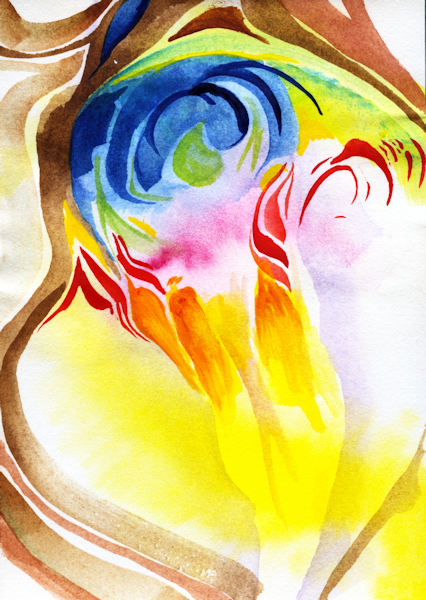
Painting by Mother Rosemary — a reminder that integrity and harmlessness can remain steady when everything else falls apart
By Amma Thanasanti
When the worst had unfolded in the monastery and I was searching for ground, I went to see Mother Rosemary—a dear friend who had lived as a professed Anglican nun for forty years. She knew our Buddhist community well and listened quietly as I shared my story. When I finished, she said only one thing:
“You have to follow your integrity.”
A few days later, she sent me a painting she’d made. To me, it carries the essence of her counsel: a vision of integrity shining through confusion and pain, of light breaking through the swirl of belonging and loss. It became an image I returned to again and again—a reminder that discernment and harmlessness can remain steady even when everything else falls apart.
When Belonging Overtakes Awakening
As nuns, we watched men arrive—sensitive, respectful, deeply committed to practice. They came with humility and reverence. But within three years, most had joined the pack. What began as genuine humility slowly hardened into subtle dismissal, entitlement, and superiority toward the nuns.
I came to see that something deeper had shifted. The longing to belong had quietly overtaken the aspiration to awaken.
This is not a flaw unique to monastics—it is a deeply human pattern. The pull of belonging runs through our nervous systems, our histories, our very sense of self. We fear exclusion more than we fear self-betrayal. And once a group’s consensus solidifies, it doesn’t just guide behavior—it becomes culture. A way of being. A lens through which everything is seen.
Culture forms not only through what is said, but through tone, body language, shared memory, silence, ritual, and unspoken expectations. It sets the boundaries of safety: who is trusted, who is centered, who is peripheral. Within such a container, conformity begins to feel like wisdom. And integrity—naming harm, breaking silence, choosing another way—begins to feel dangerous, because it risks exclusion, shaming, or exile.
And soon, preserving connection with the group feels more urgent than preserving connection with truth.
Echoes in the Wider World
The monastery was one expression of a pattern that plays out everywhere.
We see it when communities known for compassion begin echoing harsh or dogmatic views. Sometimes, this shift is born of prolonged suffering that narrows perception. Sometimes it stems from loyalty to a leader who insists this is the only way. And often, it happens inconspicuously—people conform simply because those around them do.
We see it when cruelty in leadership is tolerated—or even praised—because rejecting it would mean risking exile, disillusionment, or the loss of belonging.
Again and again, the same dynamic unfolds: the drive to belong eclipses discernment, dulls empathy, and clouds our ability to see the harm we are complicit in causing.
Ways of Noticing
Groupthink is slippery because it disguises itself as safety. Inside the group, it feels like belonging—a buffer against uncertainty, conflict, and loss. Aligning with the group soothes fear. Loyalty to a leader can feel like refuge. But when that belonging is bought at the cost of silencing others or ourselves, its foundation becomes brittle.
What feels like protection may, in fact, be complicity.
And harming others can feel protective in the moment. But it is not safe for the heart. Each small act of harm—justified or minimized—plants seeds of suffering within us. It dulls our clarity, erodes trust, and distances us from compassion. Outwardly, we may appear steady. Inwardly, we become brittle and divided—part of us straining to uphold our image, while another part quietly carries the truth of what we’ve done. This division weakens us from within, leaving us less whole, less free.
The belonging we gain through harming others is fragile, like ice too thin to stand on—it appears solid until it cracks beneath us. Fear may keep us there for a time, but the heart cannot rest on such ground. True belonging is like fertile earth beneath our feet—steady, nourishing, and alive.
When we participate in this dynamic, we are not merely protecting our place—we are reinforcing the very poisons the Buddha urged us to abandon. We deepen delusion. We harden aversion. We close the door to compassion. And we move further from freedom.
But there are signs, if we learn to listen:
- A knot inside. A tightening in the throat or stomach when something feels off.
- The hush of agreement. When honest exchange is replaced by silence or repetition.
- Recycled language. When slogans or borrowed phrases replace lived insight.
- The erosion of respect. When conviviality gives way to dismissal, superiority, or entitlement.
- A shift in values. When loyalty to a teacher outweighs commitment to ethical conduct.
- Protecting appearances. When preserving a tradition’s reputation matters more than upholding its core values.
- Avoiding accountability. When misconduct is minimized or ignored, and consequences disappear.
Noticing is the first act of freedom. It interrupts the spell. It brings what is hidden into the light.
Ways of Practicing
Once we notice, we begin to reclaim our power. Practice becomes medicine.
- Return to the body. Pause. Breathe. Feel your feet on the ground. This simple act disrupts the trance of conformity.
- Name what matters. Speak your values aloud. Write them down. Let them be your compass when the path is obscured.
- Reach for an ally. Even one person who sees clearly can offer steadiness when the group feels overwhelming.
- Create space for clarity. Time in nature or silence reconnects you to your own knowing.
- Deepen your commitment to harmlessness. If you’ve taken precepts, return to them often. Reflect on how it feels to be in the presence of someone who will not harm you—and ask: is this the gift I want to offer others?
Remember the wise guardians of the heart:
- The inner voice that recoils from causing harm.
- The sober awareness that actions carry consequences—for ourselves and for others.
These are not lofty ideals; they are quiet, steady truths. They re-anchor us in what is real.
Is Harm Ever Necessary?
In a polarized world, we are often told that harm is necessary—that cruelty is justified for the sake of safety or justice. History holds painful examples: force used to restrain violence, protect the vulnerable, or respond to grave injustice.
But the deeper question is not just what action is taken, but from what inner ground it arises.
If harm is driven by fear, rage, or retribution, it feeds the very poisons the path is meant to uproot. Even necessary restraint, if grounded in compassion—for both the vulnerable and those who cause harm—carries a different energy. It is fierce, but not cruel. Protective, but not punishing.
Harmlessness is not passivity. It can be sharp, clear, and strong. But its aim is always to minimize harm, to resist dehumanization, and to hold the sacred weight of our actions. Belonging built through cruelty is an illusion. Real refuge is rooted in integrity.
Coming Back to Discernment
In 2008, during the Pavāraṇā ceremony—a Buddhist ritual where monastics traditionally invite feedback from one another—the monks had altered the tradition in ways that redefined it as a tool of subjugation toward the nuns.
When the moment came, I couldn’t stay silent. I spoke respectfully but clearly: I could not find a place of integrity from which to participate.
Outwardly, I lost nearly everything. I became a target. I was coerced, isolated, and eventually left the community I had devoted my life to. But inwardly, something essential remained intact. I had not betrayed what mattered most.
It has taken years to recover from the trauma and exile that followed. But unlike many who endure spiritual abuse, my healing did not involve relearning how to trust myself. That trust was never broken. I had acted from a place of deep alignment. My commitment to harmlessness had held—and it continues to guide me still.
Discernment may cost us belonging in the short term. But it preserves something deeper: the belonging to ourselves, to truth, to love. A belonging no institution or authority can grant—or take away.
We may lose our way for a time, swept into silence or collusion. But we can return. And each return strengthens the ground beneath us. Eventually, discernment is no longer just a private act—it becomes a shared refuge we build together.
As the commitment to harmlessness grows, it becomes like granite. The tides of fear, longing, and loss may wash over it, but they do not move it. Even when the heart quakes, integrity remains still and steady.
A Compass in the Storm
In my own journey, Mother Rosemary’s words—“You have to follow your integrity”—and the image she painted became a compass. A reminder that integrity and harmlessness are not abstract ideals, but living forces. They can guide us when everything else collapses.
So I invite you to pause and ask:
Where in your life do you feel the pull of belonging pressing against your values? And what would it mean to let integrity—and a commitment to harmlessness—lead the way?
Reflection for Daily Life: Belonging, Integrity, and Harmlessness
Take a few quiet minutes to reflect on these questions:
- Notice the pull of belonging. Where in your life do you feel pressure to conform, even when it conflicts with your deeper values?
- Strengthen harmlessness. Recall what it feels like to be with someone you know will not harm you — the ease, trust, and safety of their presence. Do you wish to be that presence for others?
- Affirm your commitment. If you have precepts or guiding values, speak them aloud or write them down. Let them be a compass when you feel lost.
- Call on the guardians of the heart. Feel the inner sense of conscience that recoils from causing harm. Remember the wise awareness of consequences, knowing that unwholesome actions bring suffering to yourself and others.
- Return to the body. Pause, breathe, and let your feet touch the ground. Rest in the clarity that arises when you step back from the tide of conformity.



Jane Goodall — A compassionate Revolutionary

Dipa Ma: When Suffering Becomes the Path
When Belonging Costs Too Much: Discernment and Harmlessness on the Path of Awakening
Awakening Truth Newsletter!