
Photo by Stefan Lehner on Unsplash
What Happens When We Heal Our Earliest Wounds While Cultivating Inner Peace
This teaching emerged from the Enhancing Goodness retreat on November 2, 2025. What follows is a framework I’ve never heard articulated before—one that maps how healing early relationship wounds and deepening meditation practice can work together, rather than separately.
What This Article Is About
Meditation practice can bring profound benefits—clarity, peace, deep insight—and yet some patterns remain untouched. Many practitioners find that relational struggles or nervous system activation persist despite years of dedicated practice. This article explores why these domains require different kinds of attention, and how they can work together.
The Buddha told Ānanda that spiritual friendship is the whole of the holy life. Yet in decades of practicing and teaching within traditional Buddhist frameworks, I’ve found something missing: explicit practices for healing the attachment wounds and relational patterns that shape how we connect. What I’m proposing is that the path to inner freedom goes through healing our relationships, not around them—and we need tools that address this directly. And when we do this healing work alongside meditation practice, something remarkable happens we discover a full spectrum of joy that’s been waiting for us all along.
You don’t need any background in meditation or psychology to understand this. I’ll explain everything as we go.
The Gap No One Talks About
Here’s what many people discover after years of meditation practice: meditation is powerful, but it doesn’t heal everything.
You can learn to concentrate deeply, have profound insights about the nature of reality, even experience states of profound peace—and still:
- Feel fundamentally unsafe in your body
- Struggle with intimate relationships
- Carry anxiety from childhood experiences
- Find it hard to trust others
- Feel abandoned when someone doesn’t text back immediately
- Shut down emotionally when things get hard
Why? Because meditation and psychological healing work on different levels of our being.
Two Different Kinds of Wounds
Think of it this way:
Meditation works with how we relate to our present-moment experience. It helps us see our thoughts clearly, develop concentration, and recognize the nature of awareness itself. This is the realm of spiritual awakening or liberation—seeing through the illusions that cause suffering.
Psychological healing works with patterns formed in our earliest relationships. These are called attachment wounds—the ways we learned to protect ourselves when we didn’t feel safe, seen, or loved as children. These patterns live in our nervous system and show up automatically in relationships throughout our lives.
Here’s the key insight: You can’t meditate your way out of attachment wounds. They need their own kind of healing—one that happens in relationship, not in isolation.
Understanding Attachment: Why Our Earliest Relationships Matter
Before we go further, let me explain what “attachment” means in this context.
Attachment is the bond we form with our earliest caregivers. From birth through early childhood, we depend completely on others for survival. During this time, we learn fundamental lessons:
- Am I safe?
- Will someone respond when I need help?
- Is it okay to have feelings?
- Can I trust that people will be there for me?
- Am I worthy of love?
When Things Go Well: Secure Attachment
When caregivers are consistently responsive, attuned, and supportive, children develop what’s called secure attachment. This means:
- You learned the world is generally safe
- You trust others will respond when you reach out
- You can feel your emotions without being overwhelmed
- You believe you’re worthy of love and care
- You can be close to others without losing yourself
- You can be alone without feeling abandoned
When Things Are Difficult: Attachment Wounds
But many of us didn’t have this experience. Maybe our parents were:
- Inconsistent or unpredictable
- Emotionally unavailable
- Critical or dismissive of our feelings
- Overwhelmed themselves
- Physically present but emotionally absent
- Loving but unable to provide what we needed
This isn’t about blame. Most parents did the best they could with their own histories and circumstances.
But these early experiences created attachment wounds—patterns we carry into adulthood:
- Anxious patterns: Constantly worried about being abandoned, needing reassurance, difficulty trusting relationships will last
- Avoidant patterns: Keeping emotional distance, difficulty opening up, uncomfortable with closeness or dependency
- Disorganized patterns: Wanting closeness but feeling terrified of it, mixed messages about safety
These patterns live deep in our nervous system. They’re not rational thoughts we can just think our way out of. They’re automatic responses that get triggered in relationships.
Why Meditation Alone Doesn’t Fix This
Meditation happens largely in solitude. It teaches us to observe our mind and find inner peace. This is valuable and profound.
But attachment wounds were formed in relationship. They live in how we connect (or struggle to connect) with others. To heal them, we need:
- Safe relationships where we can practice new patterns
- People who respond consistently and caringly
- Experiences that teach our nervous system: “It’s actually safe to trust”
- Opportunities to have our needs met in healthy ways
This is why you can meditate for years and still feel anxious when someone doesn’t call back. The meditation helps you observe the anxiety. The attachment healing helps you not have the anxiety in the first place.
A New Framework: Joy as the Bridge
Traditional Buddhist teaching views joy as something you eventually transcend. You cultivate it early in practice, but the goal is to move beyond it toward equanimity—a calm, balanced state beyond pleasure or pain.
I’m proposing something radically different: joy is both the path and the destination. You don’t transcend the joy of feeling safe. You don’t outgrow the joy of healthy connection. These remain essential even as your practice deepens.
More importantly: joy shows up differently as both our relationships heal and our meditation deepens. By understanding this spectrum of joy, we can:
- Recognize where we are in our development
- Know what we need at each stage
- See what becomes possible as we grow
- Understand that psychological healing and spiritual awakening enhance each other
Let me show you what I mean.
The Spectrum of Joy: From Safety to Liberation
1. The Joy of Ethical Integrity
What it is: The relief and settledness that comes from living in alignment with your values—when your actions match your principles.
What it feels like:
- You can sleep without obsessing over something you said or did
- Less anxiety about being “found out” or exposed
- Ability to look at your mistakes without crushing shame
- Freedom from the exhausting work of managing your image
- Peace that comes from knowing you’re being honest
What gets in the way:
- Perfectionism: thinking you must be flawless or you’re terrible
- Carrying old shame you’ve never processed
- Following values inherited from others that aren’t actually yours
- Fear that any mistake means you’re fundamentally bad
What helps:
- Making amends when you’ve hurt someone
- Honest self-reflection without beating yourself up
- Daily small acts of integrity (returning extra change, speaking uncomfortable truths)
- Learning to distinguish between healthy conscience and toxic shame
- Having people you can talk with about ethical questions
The central question: Can I be imperfect and still fundamentally good?
In relationships: You become less defensive. You can admit mistakes without feeling worthless. You can receive criticism without collapsing. Lying starts to feel awkward and effortful rather than protective.
2. The Joy of Safety and Trust
What it is: Being able to relax in your body, in your skin, in your life. When your nervous system feels safe enough to be present.
This is the most foundational joy. Almost everything else depends on it.
What it feels like with secure attachment:
- You can reach out when struggling and trust someone will respond
- You can be upset with someone and know the relationship won’t end
- You believe people generally mean well (even when they mess up)
- You can let others see when you’re not okay
- You trust that repair is possible after conflict
- Your body feels like a safe place to inhabit
What gets in the way:
- Early trauma or neglect that created constant vigilance
- Current situations that are actually unsafe
- Using spiritual ideas to bypass your legitimate need for safety (“I should just let go and trust the universe”)
- Isolation—not having enough safe relationships
- Patterns of recreating unsafe dynamics without realizing it
What helps:
- Body-based practices: movement, breathwork, yoga
- Healing relationships where people are consistent and caring
- Community with shared values
- Healthy boundaries
- Practices that build internal resources (like the Ideal Parent Figure work I’ll explain later)
- Predictable routines and environments
Signs you’re experiencing it:
- Your belly softens instead of staying tight
- Your jaw unclenches
- You can take a full, deep breath
- You startle less easily
- Laughter comes more naturally
- You’re willing to be vulnerable
- You can be alone without panic
- You begin to sense that most people mean well
3. The Joy of Self-Regulation
What it is: Confidence that you can recognize when you’re getting overwhelmed and have tools to return to balance.
Think of it as knowing your emotional capacity (what therapists call your “window of tolerance”) and being able to come back when you’ve gone outside it.
What “window of tolerance” means: Imagine a zone where you can process experiences without either:
- Getting flooded/overwhelmed (too much emotion, can’t think clearly, panic, rage)
- Shutting down completely (numb, disconnected, can’t feel anything)
When you’re in your window, you can feel your feelings and still function. Self-regulation is about recognizing when you’re leaving that zone and knowing how to return.
What it looks like:
- Noticing: “I’m starting to get activated” (nervous system going into fight/flight/freeze)
- Being able to say: “I’m getting overwhelmed—can we pause?”
- Trusting others can help you calm down (called “co-regulation”)
- Having practices you can use when things get too intense
- Knowing who you can call when you need support
What gets in the way:
- Difficulty identifying what you’re feeling
- Disconnecting from your body as a survival strategy
- Shame about being “out of control”
- Being too isolated to get support
- Not understanding how your nervous system works
What helps:
- Learning your personal signs of getting overwhelmed
- Body scan practices (systematically bringing awareness to different parts of your body)
- Being able to name emotions
- Working with small doses of difficulty (called “titration”)
- Moving between something activating and something settling (called “pendulation”)
- Calming your nervous system with the help of another person (co-regulation)
Signs you’re experiencing it:
- You can say “I’m activated” as casually as stating “I’m wearing shoes”—it’s just information, not a crisis
- Faster recovery when you get upset
- More capacity to ask for help
- Less fear of your own emotional experiences
- Ability to say “I need a minute” without panic
4. The Joy of Feeling Fully
What it is: As attachment wounds heal, you develop capacity to feel things that weren’t safe to feel before. Your emotional range expands.
Many people with attachment wounds either feel too much (get flooded) or too little (shut down). This joy is about being able to feel the full spectrum of human emotion in healthy ways.
What it looks like with secure attachment:
- Anger without terror that you’ll be abandoned for being angry
- Sadness without collapsing into “I’m completely alone”
- Joy without immediately thinking “This won’t last” or “Something bad will happen”
- Asking for what you need without guilt or shame
- Receiving care without suspicion about motives
- Disappointing someone and trusting the relationship will survive
- Recognizing you’re imperfect and still feeling worthy of love
- Being messy, confused, upset—and trusting someone will still be there
The profound relief: Oh, I get to be a fully human being. And it’s going to be okay.
5. The Joy of Less Anxiety
What it is: A fundamental shift in your baseline nervous system state—from constant scanning for danger to generally feeling okay.
This is different from never feeling anxious. It’s about your default state changing.
What changes:
- You develop discernment (can tell real threats from old patterns)
- You don’t immediately assume the worst
- You can be uncertain without panic
- Your mind becomes quieter
- Your body relaxes as a baseline
With secure attachment:
- Someone doesn’t text back immediately—you don’t spiral into “They hate me”
- You can be in a group without constantly monitoring for danger
- You trust that if something’s wrong, people will tell you
- You don’t need to be hypervigilant to feel safe
Signs you’re experiencing it:
- Less catastrophizing
- More confidence you can handle what comes
- Ability to be with uncertainty
- Quieter mental chatter
- More relaxed body
- Can enjoy being with others without exhaustion from scanning for threats
6. The Joy of Settledness and Simple Presence
What it is: Being here for simple things. Delight in the ordinary. A sunset, a meal, a conversation, a flower, a child smiling, seeing a puppy.
This is presence without agenda—the capacity to savor what’s happening now without needing anything else to feel okay.
In relationships:
- Being present with someone without multitasking
- Really listening, not just waiting to talk
- Enjoying silence together
- Delighting in simple shared experiences—a walk, a meal, sitting on a porch, a hug
What blocks it:
- Anxiety keeping you three steps ahead
- Inability to open to pleasure
- Always seeking the next thing
- Rest feeling like failure
- Constant digital distraction
What helps:
- Slowing down
- Really tasting your food
- Feeling textures
- Pausing for things that make you light up
- Walking meditation (slow, mindful walking with awareness of each step)
- One-thing-at-a-time practice
- Gratitude practice
- Removing distractions deliberately
Signs you’re experiencing it:
- Time seems to expand
- Colors seem more vivid
- Moments of spontaneous awe
- You remember what you ate and how it tasted
- Genuine interest in someone else’s experience
- Contentment without needing stimulation
- Smiling for no reason
7. The Joy of Deeper Concentration
What it is: When the mind gathers and can rest with one thing—whether it’s the breath, a phrase, or another object of attention. This brings both pleasure and profound mental clarity.
In Buddhist tradition, these are called jhānas (in Pali) or samadhi (in Sanskrit)—deep meditative absorption states where the mind becomes unified and still.
What happens:
- Sustained awareness without being pulled away by thoughts
- Physical sensations: tingles, warmth, energy flows
- Deep happiness that’s not dependent on anything external
- Eventually, thoughts quiet completely
- The sense of being a separate “me” watching experience begins to soften
- You experience consciousness itself
In relationship:
- Feeling the collective support of a group
- Sensing the shared field of awareness
- Recognizing how safety in community allows deeper letting go
- Understanding how practicing together deepens everyone’s experience
What supports it:
- Regular meditation practice
- Movement practices
- Body scanning
- Loving-kindness meditation (cultivating warmth and care, first for yourself, then others)
- Extended retreat time
- Extended nature time
- Practicing in groups
Signs you’re experiencing it:
- Breath becomes very subtle, almost imperceptible
- Body feels energized but still
- Sense of edges softening
- Time distortion
- Effortless attention
- Deep refreshment
- Less interest in following thoughts
8. The Joy of Belonging and Contributing
What it is: Feeling part of something larger than yourself. Knowing what you do matters. Experiencing mutuality, reciprocity, being seen and seeing others. The pleasure of healthy interdependence.
With secure attachment:
- You can offer help without needing to be needed
- You can receive help without feeling like a burden
- You trust your place in community even when you’re not contributing
- You can be authentically yourself and still belong
- You can have conflicts and trust repair is possible
What blocks it:
- Believing you must do everything alone
- Shame about having needs
- Previous relationship wounds that haven’t healed
- The idea that spiritual practice is private and solitary
- Being able to give but unable to receive
What helps:
- Being part of a practice community (sangha—spiritual community) where interdependence is normalized
- Offering service
- Sharing your practice with others
- Learning to receive help
- Group practice
- Accountability partnerships
Signs you’re experiencing it:
- Genuine interest in how others are doing
- Asking for help feels natural
- Celebrating others’ success without envy
- Feeling part of something collective
- Connecting with others gives you energy rather than drains it
- Less loneliness even when alone
9. Sustained Body Joy
What it is: Aliveness. Embodied presence. Pleasure that doesn’t need to be feared. The feeling of happiness as sustained energetic openness in your body.
Many spiritual traditions teach transcending the body. This joy is about fully inhabiting your body.
In relationships:
- Safe contact and touch
- Knowing you can be held without it needing to be sexual
- Feeling nourished by others’ presence
- Your body relaxing around trusted people
- Play, movement, dance
What blocks it:
- Shame about the body
- Split between “spiritual” and “physical”
- Trauma where pleasure triggers defensiveness
- Teachings that frame the body as something to transcend
- Burnout and depletion
- Chasing intense experiences instead of sustainable presence
What helps:
- Yoga, qigong, dance
- Body practices that unify awareness with movement
- Bodywork and massage
- Breath practices
- Working with subtle energy
Signs you’re experiencing it:
- Body feels like home, not a vehicle or problem
- Aliveness without agitation
- Pleasure without immediately craving more
- Breath flows freely
- Energy flows without blockages
- Relaxed alertness
- A sense of your cells smiling
- Receiving touch without freezing or immediately sexualizing
10. The Brahma viharas: The Qualities of an Open Heart
What these are: In Buddhist tradition, the brahma viharas (literally “divine abodes” or “heavenly dwelling places”) are four qualities of an open heart:
- Metta: Loving-kindness, benevolence, goodwill
- Karuna: Compassion, the capacity to be with suffering
- Mudita: Sympathetic joy, happiness in others’ happiness
- Upekkha: Equanimity, balanced care that’s not attached to outcomes
These are both practices that you can cultivate as well as natural states when your heart is open and secure.
With secure attachment:
- You can love someone and disagree with them
- You can be genuinely happy for someone else’s good fortune
- You can offer compassion without taking on their pain
- You can have clear boundaries and still deeply care
- Your heart can break from grief, and you can still stay open
What blocks it:
- Protecting against being hurt by closing your heart
- Taking on others’ pain without boundaries
- Enabling rather than truly helping
- Loving everyone except yourself
- Superficial sentiment without depth
- Transactional love (I’ll care if you care back)
- Being conditioned to be “nice” rather than genuinely kind
What helps:
- Loving-kindness meditation (systematic practice of generating goodwill)
- Tonglen: a Tibetan practice of visualizing taking in others’ suffering and sending out relief
- Grieving and forgiveness work
- Befriending younger parts of yourself that still carry wounds
Signs you’re experiencing it:
- Warmth in your heart
- Genuine delight in others’ good fortune
- Spontaneous kindness that’s not performed or calculated
- Holding pain without either collapsing or hardening
- Less judgment
- Tears flow more easily
- Wanting to give without martyrdom or resentment
- More yes for life
11. The Joy of Insight and Liberation
What it is: Seeing through the veils of illusion. Direct knowing of your own nature. Freedom from mistaken identification with thoughts, emotions, or fixed ideas of who you are. Lightness of being. Recognition of awareness itself.
This is what Buddhist traditions call awakening, enlightenment, or liberation—seeing the truth of how things actually are, which brings profound freedom.
Each genuine insight brings its own delight—not because you’ve achieved something, but because you’ve recognized what was always true.
In relationships:
- Being with others feels effortless
- You can be alone without loneliness
- You can be with others without losing yourself
- Less need to manage how you’re perceived
- Conflicts don’t threaten your sense of who you are
- You can be intimate without fear of losing yourself (engulfment)
- You can be separate without fear of abandonment
- Joy with others and joy alone both feel natural and complete
From a relational perspective: Your awakening isn’t separate from relationship. It includes and embraces connection.
Signs you’re experiencing it:
- A sense of “of course”—the obviousness of what’s always been true
- Laughter at the cosmic joke
- Simultaneous ordinariness and profundity
- Less contraction, literal sense of unburdening
- Less concern with your image
- More space around everything
- Less need to defend yourself
- Simplicity—complications naturally fall away
- Confidence that’s not based on achievement or performance
- Peace that’s not solely dependent on external circumstances
- Recognition that awareness was never not here
- Ease with both solitude and intimacy
The Spiral Path: How These Joys Build on Each Other
Here’s what’s crucial to understand: These joys aren’t a ladder you climb, leaving lower rungs behind. They’re a spiral that you move through, with each level supporting and enriching the others.
Key Principles:
1. Foundation matters You can’t access the joy of liberation without the foundation of safety. We need ethical integrity, basic nervous system regulation, and secure enough attachment for deeper states to stabilize.
2. The path is developmental but not linear Generally, these joys develop in sequence. But at any point, you can have glimpses of “higher” joys—and those experiences can actually help you build stronger foundations.
You might have a profound meditation experience that shows you what’s possible, and that glimpse motivates you to do the harder work of healing attachment wounds.
3. Deep insights still require integration You can touch liberation and still need years of integration work. The insight is real but stabilizing it in your daily life—especially in relationships—takes time.
4. All joys remain relevant You don’t transcend the joy of feeling safe. You don’t outgrow the joy of healthy connection. These remain essential even as you develop profound concentration or liberating insight.
5. Different practices emphasize different joys
- Classical meditation emphasizes concentration and insight (joys 7, 11)
- Ethical practice emphasizes integrity (joy 1)
- Body-based practices emphasize embodiment and regulation (joys 2, 3, 9)
- Relational healing emphasizes attachment security (joys 2, 4, 5, 8)
- Heart practices emphasize the brahma viharas (joy 10)
The Integrated Meditation approach includes all of them, recognizing they work synergistically.
Why Attachment Repair as Spiritual Practice
Now I want to explain something I believe is essential, though I’m aware it’s not commonly done: combining traditional meditation with explicit attachment repair work.
As far as I know, the Integrated Meditation Program is the only program doing attachment repair as a core community practice. Here’s why this matters:
The Traditional Approach Misses Something Critical
Traditional meditation practice assumes you arrive with enough psychological foundation. It teaches you to observe your mind, develop concentration, and investigate the nature of reality. This is profound and valuable.
But if you don’t have basic nervous system regulation, if you haven’t developed secure enough attachment patterns, if you’re carrying significant trauma—the practice often doesn’t go as deep as it could. Or worse, it can be destabilizing.
Think about it: If your nervous system learned early on that the world is dangerous and people can’t be trusted, sitting alone in meditation can actually activate that trauma. The stillness isn’t peaceful—it’s threatening.
The Missing Foundation
Traditional Buddhist practice often emphasizes transcending attachment. But there’s a crucial distinction that gets lost:
- Secure attachment (healthy human bonds) is different from clinging attachment (desperate grasping from fear)
- You can’t healthily transcend attachment if you never had secure attachment in the first place
- What looks like spiritual non-attachment can actually be avoidant attachment—a defense against intimacy
We can’t transcend what we’ve never had.
What We’re Doing Differently
In the Integrated Meditation Program, we’re being explicit about both paths:
1. We practice meditation for concentration, insight, and recognizing the nature of awareness
2. We practice attachment repair through the Ideal Parent Figure protocol
What is the Ideal Parent Figure (IPF) protocol? It’s an evidence-based practice where you:
- Imagine ideal caregivers who embody exactly what you needed as a child
- Visualize these figures offering you five essential qualities:
- Safety: “You’re safe. I’ll protect you.”
- Attunement: “I see you. I understand what you need.”
- Comfort: “I’m here when you’re hurting.”
- Delight: “I’m so happy you exist.”
- Encouragement: “I believe in you. You can do this.”
- Practice receiving these qualities repeatedly until they become internalized
- Your nervous system begins to shift its baseline patterns
This isn’t just visualization. Done consistently, it creates new neural pathways. Your nervous system starts to experience: “Oh, this is what secure attachment feels like. This is safe.”
3. We do this work in community (sangha)
We practice together in:
- Dyads: Structured one-on-one practice conversations
- Triads: Three-person practice groups
- Peer partnerships: Ongoing support between sessions
Why community? Because attachment wounds were formed in relationship. They heal in relationship.
You can do IPF practice alone, and it helps. But doing it in the context of safe, consistent, attuned relationships accelerates and deepens the healing. Your nervous system gets lived experience: “People actually can be trustworthy. Connection actually can be safe.”
Why This Integration Works
The developmental foundation and awakening practice move together.
It’s like building a house: you need a foundation before you can put on a roof. The early joys—safety, regulation, ethical integrity—are foundational. Without them, concentration and liberating insights don’t stabilize. You might have profound experiences, but you can’t integrate them into daily life.
When the five qualities become sufficiently present (safety, attunement, comfort, delight, encouragement), your baseline patterns shift. As these patterns shift, you gain more capacity to make good use of traditional meditation practices.
You begin to recognize what all these joys point to: the capacity for being is inherently pleasurable.
The Classical View vs. Our Approach
From a classical Buddhist perspective:
- Joy arises through practice
- It settles into equanimity
- Equanimity is the more refined state
- Joy is ultimately transcended
This makes sense within that framework. But it can lead to:
- Dismissing the importance of foundational joys
- Bypassing developmental needs for “higher” states
- Leaving practitioners with insights they can’t integrate into relationships
In our approach:
- Joy is both developmental and enduring
- You don’t transcend the joy of safety or ethical integrity
- All levels remain relevant even as practice deepens
- The five qualities aren’t luxuries—they’re essential supports
- Relational repair creates the foundation classical practice often skips
Attachment repair isn’t just fixing what’s broken. It’s building capacity to experience the foundational joys that make deeper practice possible. It’s stabilizing insights that might otherwise slip away. It’s integrating awakening experiences instead of having them remain as fleeting peak moments.
The Path to Your Inner Source Goes Through Relationship
This is the core insight: The path to discovering your inner source of well-being—your deepest nature, your capacity for peace—doesn’t go around relationship. It goes through it.
Secure attachment and awakening aren’t separate developmental paths that happen to coexist. They’re mutually enhancing:
- Relational healing opens doors in meditation practice that weren’t previously accessible
- Deepening meditation practice enriches your capacity for healthy relationship
- The joy of secure attachment creates the foundation for liberating insight
- Liberating insight transforms how you show up in relationship
When both are happening together, they work synergistically rather than sequentially. This is why participants in the Integrated Meditation Program report such profound results.
This is the relational path to freedom.
What This Means For You
Whether you’re:
- New to meditation and curious about starting
- An experienced practitioner wondering why relationships are still hard
- A therapist interested in integrating contemplative practice
- Someone who’s done a lot of therapy but not meditation
- Anyone exploring how to live with more peace, connection, and joy
This framework offers a map:
- You don’t have to choose between psychological healing and spiritual development—they enhance each other
- You can recognize where you are on the spectrum and what you need next
- You can understand why certain practices work for some people but not others (they’re addressing different joys)
- You can see that struggles in one area don’t mean you’re failing—they mean you need to tend to a different level
- You can trust that the full spectrum of joy is available to you
The capacity for peace, for connection, for freedom, for love—it’s not something you have to earn or achieve. It’s something you uncover by:
- Healing what blocks it
- Cultivating the conditions that allow it to emerge
- Recognizing it was never actually absent
Learn More
The Integrated Meditation Program is a 6-month cohort-based program combining the Ideal Parent Figure protocol with SHINE meditation practice—a practice created by the founders of Awakening Truth specifically to enhance goodness and well-being.
The program creates a relational container for both attachment repair and contemplative deepening. This is why participants experience such excellent results: the practices work synergistically rather than sequentially.
To learn more about the Integrated Meditation Program: https://awakeningtruth.org/integrated-meditation/
To learn more about SHINE practice: https://awakeningtruth.org/blog/shine-a-practice-for-staying-resilient-when-the-news-wont-stop/
To watch the full talk this article is based on: https://youtu.be/Pj27cv1VY1I
About the Author
Amma Thanasanti has practiced meditation since 1979 and has been teaching since 1989. She spent 26 years as a Theravāda Buddhist nun, including 20 years living in monasteries in the Ajahn Chah tradition. Her root teachers—Jack Engler, Ajahn Chah, Dipa Ma, and the Dalai Lama—continue to influence her work today.
Jack Engler’s seminal insight—”you have to develop a self before you let go of a self”—has shaped her teaching from the beginning. She has been bridging deep contemplative practice with depth psychology for decades, recognizing that spiritual awakening and psychological development are not separate paths but mutually necessary.
She is the Spiritual Director and founder of Awakening Truth, a nonprofit organization dedicated to integrating traditional Buddhist teachings with trauma-informed practices. She created the Integrated Meditation Program after recognizing that meditation alone doesn’t address the attachment wounds and developmental patterns that shape our capacity for genuine freedom and connection. This framework—weaving secure attachment through the stages of liberation—emerged from decades of practice, teaching, and her own journey of integrating profound insight with relational healing.
What moves through her teaching is what she has lived: deep meditative experiences, classical dharma training, and the embodied understanding that the path to inner freedom goes through relationship, not around it.
Website: awakeningtruth.org
A Note on This Framework
This teaching represents a groundbreaking integration of attachment theory and classical Buddhist meditation that I have not encountered anywhere else. While many teachers address psychology and meditation, I’ve never heard anyone explicitly weave secure attachment through the stages of liberation as a comprehensive developmental map.
If you find this framework valuable, please consider supporting this work through a generous offering at awakeningtruth.org/donation. These teachings are offered freely to make them accessible to all, and your generosity—whatever amount is meaningful and affordable for you—helps sustain this work.
Thank you for reading. May you discover the full spectrum of joy that’s waiting for you.

Photo by Marc-Olivier Jodoin on Unsplash
In 1979, when I was seventeen, I met a teacher named Jack Engler who introduced me to Buddhist meditation. From that first class, something inside me recognized the path I’d been looking for. Within a month, I could see myself as a nun, and held open the wish to travel Southeast Asia to study with the meditation masters I’d heard about—Ajahn Chah, Dipa Ma, Ajahn Buddhadasa—those who lived, breathed and totally embodied the Dhamma.
Eight years later, the conditions ripened. I quit my job as an analytical chemist, gave away everything I owned, found a home for my cat Tasha, and bought a one-way ticket to Kathmandu. I was twenty-five and ready to dedicate my life to awakening.
The Journey Into the Mountains
Nepal was vibrant and disorienting. The longer I stayed, the more unsettled I became. I’d never been this far from home, this long. I missed my family and friends. So I followed my oldest compass: head into nature.
I flew to Delhi and in 125-degree heat made my way to the Himalayan foothills, to McLeod Ganj—home to His Holiness the Dalai Lama and the Tibetan government in exile. There I met Brian, a traveler my age who seemed kind, grounded, safe. I asked if he’d join me on an overnight hike into the mountains. He said yes.
We packed food, hiked into cool mountain air, ate wild strawberries along the way, and reached Triund—a high ridge ten thousand feet above Dharamsala. We spread out our sleeping bags and slept under the stars.
That night was two days before the full moon in May—Vesak, the Buddha’s birth, awakening, and death. A blue moon. Rare and auspicious.
What Emerged
The next morning, we left our packs to explore a nearby canyon. I stood in front of a boulder and noticed a cave. “Brian, did you see—”
And then it came.
A sound like nothing I’d ever heard—part roar, part growl, part snort—and from six feet away, a massive black bear charged straight at me.
When the bear’s face was two feet from mine, I went for refuge, screamed, jumped—and blacked out.
When I came to, my belly was pressed against a branch, the bear’s body along my back, its jaws chewing my head.
The first moment of consciousness was pure, unbounded fear—no edges, no space around it, just total immersion.
But right next to that fear was the knowing of fear.
And then a thought: There’s no point in being afraid. You’re going to die.
With that, something released. The body softened. The mind opened. Fear vanished.
Then—joy. Luminous, radiant joy. Clarity. I watched sensations and thoughts arise and pass. In fear’s place was curiosity: What will it be like to watch this mind and body dissolve?
The bear was still chewing on my head.
From that stillness came the sound of “Om.” Not something I’d practiced, not something I expected. It arose on its own. I turned my attention toward it.
The instant the mind turned to rest upon that sound, the bear left.
The Sound of Kindness
When Brian reached me, he said, “You’re not that badly hurt.”
It was such a kindness. My head and neck were covered in gashes, but my skull was intact. Eventually we made it back to our big packs where Brian cleaned and bandaged me. We hiked down for three hours. At the clinic, the doctors expected mangled remains. Instead, I walked in laughing.
Later that night, when the bliss wore off and pain arrived, I lay on a cot, tears streaming. There must be a reason I’m still alive. I just don’t know what it is.
Weeks later in Nepal, one wound refused to heal. A doctor finally removed a seed pod lodged in my scalp that had been between the bear’s teeth. After that, the wound closed. I continued to Thailand, visited monasteries and each of the masters I had wanted to meet. Eventually I was ordained as a Buddhist nun in the UK.
What I Understood Then
For many years, I understood what happened through a purely spiritual lens: in the presence of awareness, profound surrender became possible and fear vanished. What became available in surrender was unimaginable without it. My faith in meditation was confirmed—the practice of awareness truly liberates.
What I See Now
Decades later, with a deeper understanding of trauma and the nervous system, I can see what happened on that mountain more clearly. My nervous system somehow stayed within its window of tolerance, allowing awareness to meet terror directly. But I’ve since learned that when we’re pushed beyond that window—when we’re stuck in overwhelmed—awareness may not be enough. We need smaller steps, gentler pathways back to regulation. Often we need co-regulation—finding our way back into awareness of what is going on with the safe, grounded, and loving presence of another person, animal, tree, rock, or body of water.
This is the same process I now guide others through—learning to discern what’s needed in each moment, and developing the tools, resources, and practices that support us, including co-regulation. It’s about expanding our capacity to stay present and embodied—especially when every instinct says to flee, numb, or collapse—so we can meet life with greater steadiness, compassion, and connection.
The bear taught me that presence isn’t the absence of fear—it’s the capacity to stay with what is, and keep the heart open, even there.
In a world facing wars, genocide, climate collapse, and the breakdown of democracy, this matters. We need the capacity to meet what’s unbearable without turning away—and without being destroyed by it.
The Second Bear
Years later, after my father died, I sat quietly in the Garden of the Gods in Colorado. A young she-bear approached. She walked right up to me, her eyes level with mine. She paused, looking me right in the eyes and touched her nose to my knee—then startled and fled.
My heart pounded wildly. And then again: the blessing.
That meeting closed a circle. The first bear shattered the fallacy that we can ever truly know what the next moment will bring — or even whether we’ll still be alive for it. The second revealed the intimacy that becomes possible when we’re fully present to the totality of life itself.
The Teaching
Most of us spend our lives trying to secure what we want and push away what we fear. Yet in that first encounter, even as the bear chewed my head, there was clarity, joy, and luminous presence. The blessing wasn’t that I survived; it was the knowing that I was at peace — that I would be okay, whatever the outcome, even if that outcome was death.
By the time of the second encounter, after tending to some of the many layers of trauma and fear, I could meet the bear differently — alert but unafraid, fully alive to the mystery and intimacy of being connected with all of life.
For many years I understood the first encounter as an initiation into the bear clan — a sacred exchange between species, a transmission of power through surrender. And that was true in a way. But after doing shamanic work, I came to see something else. The bear had also left an energetic imprint — an attachment of its spirit within me that wasn’t entirely wholesome. It wasn’t about belonging to the bear clan; it was about remembering the power of surrender and learning to discern what entered through that opening.
The second bear reminded me of what becomes possible when we’ve done the work of clearing trauma residues from the body and psyche. Then life can move through us freely — alive, fresh, open to connection.
The first encounter showed me surrender.
The second revealed belonging.
Postscript
What the bears taught me—to stay awake in the middle of terror, to soften around fear, to return again and again to presence—is what I now share through the Integrated Meditation Program: a collaborative practice that blends mindfulness, emotional attunement, and the science of neuroplasticity.
This work helps us, individually and collectively, to shift our baseline patterns—to become more resilient, more connected, and more capable of meeting both the fierce and the beautiful in our world, not as enemies but as invitations to awaken.
And in times like these, when so much invites us to turn away or harden, this capacity—to stay open, embodied, and connected in the midst of suffering—may be the most essential gift we can offer.

Light breaks through, even in the storm. This is the practice.
The Problem: Your Brain is Wired for Survival, Not Happiness
Our brains evolved with what neuroscientists call a “negativity bias”—we’re hardwired to notice, focus on, and remember negative experiences more than positive ones. This made perfect sense for our ancestors: the early human who remembered where the predators were lived longer than the one who just enjoyed the sunset.
But in modern life, this survival mechanism creates problems. We scan constantly for what’s wrong, what’s dangerous, what might hurt us. Our nervous systems stay activated, ready for threats. And over time, we can get stuck feeling and sensing danger everywhere.
This is especially challenging right now. We’re not just reading heartbreaking and scary news—we’re living it. Whether it’s us, our loved ones, or our neighbors—people we care about are being targeted. Rights we had a year ago have disappeared. Making ends meet feels impossible. We’re waiting to find out if we or the people we love will be harmed by current policies. Our nervous systems are overwhelmed by legitimate, immediate threats alongside the everyday stresses of modern life. The negativity bias, combined with this relentless reality, can leave us feeling helpless, frozen, or perpetually activated.
When the System Gets Jammed
Some people—particularly those dealing with chronic illness, trauma, or prolonged stress—can find their limbic systems stuck in hypervigilance. When this happens, the brain can become hypersensitive to everything “wrong” or “bad,” interpreting neutral situations as threats. If you notice this pattern in yourself, you need tools to actively rewire your nervous system toward safety and wellbeing.
One effective approach is intentionally cultivating positive emotional states—not to deny real problems, but to give your nervous system new information: not everything is a threat. This isn’t “toxic positivity.” It’s strategic nervous system regulation.
The Paradox: How Can We Focus on Goodness When Harm Is Real?
Here’s the tension many of us feel: How can we practice noticing positive states when harm is actively happening now?
Doesn’t focusing on positive experiences mean ignoring suffering? Isn’t it a form of spiritual bypassing or toxic positivity?
No. Here’s why:
When your nervous system is constantly activated, you lose capacity—but not because vigilance itself is wrong.Scanning for real threats is reasonable and necessary right now. The problem is when we get stuck: frozen in helplessness, oscillating between panic and collapse, or carrying a constant baseline of anxiety and overwhelm that drains our energy even when no immediate action is required.
This chronic activation makes us less effective—not because we care too much, but because managing perpetual stress takes enormous energy. Energy we need for discernment, strategic thinking, and sustained action.
We need practices that help us recognize:
- What needs immediate attention (and marshaling resources to respond)
- What is draining us without requiring action right now (and learning to regulate)
- When we need to stop completely and nourish ourselves before we can engage meaningfully again
SHINE practice isn’t about denying reality or forcing yourself to “just be positive.” It’s about building the capacity to discern what’s actually happening in your nervous system and respond skillfully—engaging when engagement serves, regulating when you’re spinning, and nourishing when you’re depleted.
Think of it like this: You can’t think strategically, act effectively, or sustain solidarity when your nervous system is stuck in threat response. But you also can’t assess what’s actually threatening vs. what’s your nervous system’s pattern unless you have capacity to regulate.
Cultivating positive emotional states isn’t escapism—it’s strategic nervous system regulation. It gives you the space to:
- Discern what actually needs your energy right now vs. what’s anxiety’s escalation
- Think clearly about complex problems rather than collapsing into despair
- Act effectively rather than freezing or flailing
- Sustain engagement over the long haul rather than burning out in three months
- Stay connected to others rather than isolating in overwhelm
- Maintain hope without denying reality
The people and causes you care about need you able to discern, regulate, and act—not burnt out, frozen, or running on empty.
SHINE practice doesn’t turn away from harm. It builds the capacity to face harm skillfully, knowing when to engage, when to regulate, and when to nourish.
Why We Need Active Practice
Here’s the challenge: our brains won’t automatically shift toward positive experiences just because we want them to. The negativity bias is too strong. We need active, intentional practice to:
- Notice positive experiences (they’re often there, but we miss them)
- Stay with them long enough to let them register (not just glance and move on)
- Let them sink in (this is where the rewiring happens)
- Strengthen the neural pathways that recognize safety, joy, and connection
As neuropsychologist Rick Hanson explains, our brains are “Velcro for negative experiences and Teflon for positive ones.” Negative experiences stick immediately and strongly. Positive experiences slide right off unless we actively help them stay.
Enter SHINE
I developed SHINE specifically to support us during these challenging times. Inspired by Michelle McDonald’s RAIN practice (which Tara Brach has used extensively to work with difficult emotions), SHINE offers a parallel structure for working with positive experiences.
SHINE is a structured approach to cultivating and sustaining positive emotional states:
Sense: Notice when something positive is present—ease, warmth, joy, safety, connection, gratitude, or simple contentment. This could be as small as the warmth of your hands, the comfort of your breath or as profound as feeling grateful to have a roof overhead and loved ones.
Hold: Stay with the positive experience. Don’t let it slide off into the next thought or worry. This is harder than it sounds—our minds want to move on, check for problems, plan the next thing. Practice dwelling in the goodness. Sustaining your attention, and gently guiding it back without judgement.
Inquire: Get curious about the positive experience. Where do you feel it in your body? What qualities does it have? What happens when you give it your full attention? Inquiry deepens the experience and helps it register more fully.
Nourish: Tend to the positive experience the way you’d nourish a garden—water it with your full attention, fertilize it with curiosity and openness, gently weed away the distractions, negativity, and doubt that would crowd it out. Notice if it naturally spreads through your body, touches your emotions, or shifts your understanding. You’re not making it grow; you’re creating the conditions where it can flourish.
Extend: Take the positive experience into imagination. See yourself walking through the world with these feelings in the future. First start simply, just seeing the positive feeling continue past the formal practice time. So if it started as the warmth of your hands, imagine carrying that warmth with you through different situations—a moment of uncertainty, an unpleasant task, an awkward social situation. This practice takes what’s happening in the present moment and with imagination, extends it forward in time, strengthening the possibility that your system can access these states when you need them.
A Note on Extend: While extending positive experiences into imagination is different from some meditation practices that emphasize simply observing what is, it’s particularly helpful when working against the negativity bias. By rehearsing positive states in imagined future scenarios, we’re actively rewiring our systems—teaching our brains that these states are available not just on the cushion, but in life.
Why This Matters for Healing
For people whose nervous systems are stuck in stress response:
- SHINE provides active rewiring toward safety and wellbeing
- It’s not about ignoring problems but about giving equal attention to what’s working
- It helps create new neural pathways that recognize and sustain positive states
- It teaches the nervous system that not everything requires vigilance
For everyone navigating these difficult times:
- We all need practices that counter the constant barrage of bad news
- Positive emotional states support resilience, immune function, and our capacity to engage with real problems without burning out
- The capacity to sustain wellbeing is a skill that can be developed through practice
- SHINE helps us stay resourced so we can show up for what matters
The Practice is Simple, Not Easy
SHINE practices are deceptively simple. You’re just noticing something good and staying with it. But if you try it, you’ll quickly discover how much your mind wants to move away from positive experiences:
“Yes, this is nice, but I need to remember to…” “This feels good, but what about all the terrible things happening in the world…” “I shouldn’t feel this good when…”
These patterns reflect the negativity bias at work. Your brain thinks focusing on problems is more important than savoring goodness. SHINE practice trains your brain differently—not to ignore problems, but to build the resilience needed to address them sustainably.
SHINE as Practice for These Times
We’ve created SHINE workshops and retreats to support you in developing these practices. Rather than just reading about the negativity bias, you can experience firsthand how to work with it—learning tools you can use immediately to build resilience in difficult times.
Check our calendar at awakeningtruth.org for upcoming offerings:
SHINE Workshops (2 hours)
Experiential introduction to SHINE practice including:
- Guided meditation exploring each element of SHINE (Sense, Hold, Inquire, Nourish, Extend)
- Understanding the neuroscience of negativity bias and how it affects your daily life
- Practical tools for daily use—simple practices that don’t require lengthy meditation sessions
- Working skillfully with the mind’s resistance to positive states (which is more common than you might think)
- Learning to carry positive experiences into challenging situations through imagination
You’ll leave with concrete practices you can use immediately—not just concepts to think about, but embodied skills for working with your nervous system.
No prior meditation experience required. All you need is willingness to experiment with cultivating wellbeing even in difficult times.
SHINE Half-Day Retreats (3 hours)
Want to go deeper? Join us for extended SHINE practice with meditation, teaching, and community connection. These retreats are offered freely—perfect for bringing friends, family, or colleagues. You’ll hear from IMP (Integrated Meditation Program) alumni about how these practices have transformed their lives.
Space is limited. Registration required.
Trauma-Informed Mindfulness Series
We’re living through collectively traumatic times, and many of us—along with our families, colleagues, students, and clients—are navigating nervous system dysregulation. This series offers frameworks and tools that make mindfulness practice safe and accessible, whether you’re dealing with your own overwhelm or wanting to support others more skillfully and compassionately.
Learn how to work with mindfulness in ways that support healing rather than triggering. If meditation sometimes feels activating rather than calming, or if you’re watching loved ones struggle with overwhelm and don’t know how to help, these tools will serve you.
All offerings available at awakeningtruth.org/calendar
These practices build the capacity to discern, regulate, and act—so you can stay engaged with what matters without burning out or becoming overwhelmed.
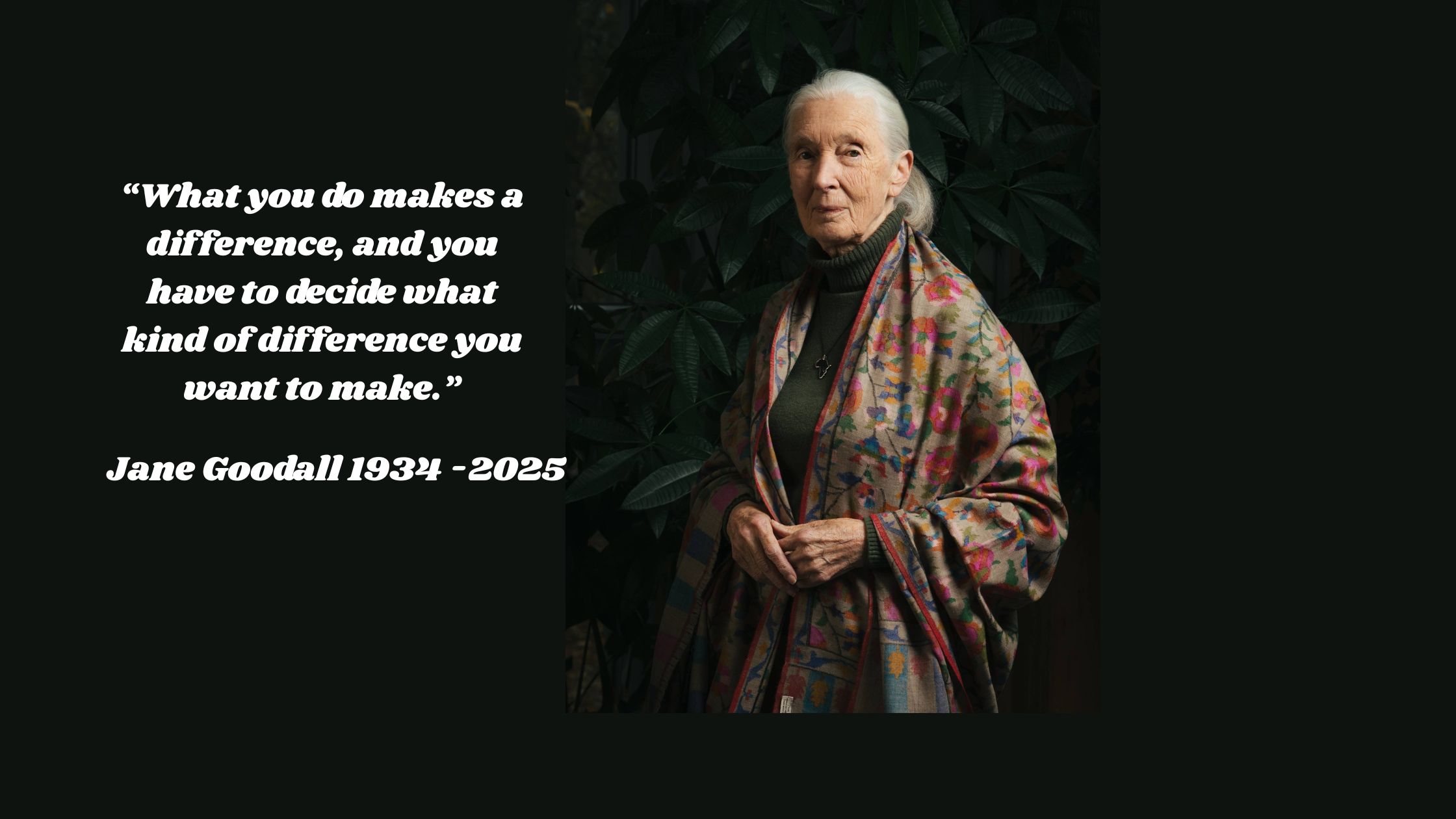
Jane Goodall didn’t just study chimpanzees – she revolutionized how humans understand kinship, intelligence, and what it means to truly see another being.
When she arrived at Gombe Stream in 1960, the scientific establishment told her she was doing it all wrong. She gave the chimpanzees names instead of numbers. She described their personalities, their emotions, their relationships. She sat with them, patient and present, until they trusted her enough to let her witness their lives.
The world said: “You’re being too subjective. Too emotional. Not scientific enough.”
She said: “I’m being accurate.”
And she was right.
What Jane Taught Us:
See the individual, not the category. David Greybeard wasn’t “Subject 4.” He was David Greybeard – curious, gentle, the first to trust her, the one who held her hand.
Patience is a practice. She didn’t rush. She didn’t force. She waited, observed, returned again and again until understanding emerged naturally.
Challenging systems requires both courage and data. She faced a scientific establishment that dismissed her methods, and she responded not with rage but with meticulous documentation that could not be denied.
Compassion and rigor aren’t opposites. Her love for the chimpanzees made her science better, not worse. Her emotional attunement allowed her to see what detached observation missed.
Everyone matters, not as isolated units but as threads in a living whole. She saw how chimpanzees shaped their troop, one person’s choice affects a community, ecosystems depend on each member. She understood that each life affects the whole, that small acts of attention and care shift patterns in ways that spread beyond what we can track.
Hope is a choice we make every day. Even as she witnessed habitat destruction, poaching, and climate crisis, she refused despair. She built youth programs, conservation efforts, and coalitions. She showed up. She kept going.
Her Legacy Lives on
Jane’s legacy lives in work that goes to the places that need it most—spaces where people have been categorized instead of seen, where emotions have been pathologized instead of honored, where rushing has replaced patience, where power has drowned out attunement. When we show up there with the same patience, the same seeing, the same refusal to accept harm as inevitable—we keep her spirit alive.
We’re building bridges between scientific understanding and embodied wisdom. We’re teaching people that healing doesn’t come from detachment but from brave, patient presence – with ourselves and each other. We’re creating practices that help people discover they’re not broken, just human. We’re training facilitators to hold space the way Jane held space: with curiosity, with steadiness, with genuine delight in each person’s unique unfolding.
Jane proved that revolution doesn’t require violence – it requires seeing clearly and refusing to look away. It requires showing up every day with both rigor and tenderness. It requires believing that change is possible even when systems tell you it isn’t.
She spent sixty years sitting in the forest, refusing the false choice between heart and mind, between compassion and science, between personal transformation and systemic change.
That’s the work now – in meditation halls and therapy rooms, in trainings and small groups, in forests both literal and metaphorical. Helping people remember they belong to each other and to this living world. Teaching them to see, really see, the beings right in front of them. Supporting them to experience what Jane knew: that patient, attuned presence doesn’t solve everything, but it changes the ground we stand on.
Jane once said:
“What you do makes a difference, and you have to decide what kind of difference you want to make.”
She decided to trust what she saw, even when the scientific establishment told her she was wrong.
That’s the inheritance: the courage to trust our own clarity when institutions dismiss it, to honor our attunement when systems call it weakness, to know that connection matters, with all beings, even when there are pressures to divide and categorize.
When we honor the persistence that lives in all of us—the part that keeps choosing to see, to connect, to trust that showing up matters—we are honoring Jane Goodall.
Amma Thanasanti
By Amma Thanasanti
“The whole path of mindfulness is this: Whatever you are doing, be aware of it.” — Dipa Ma
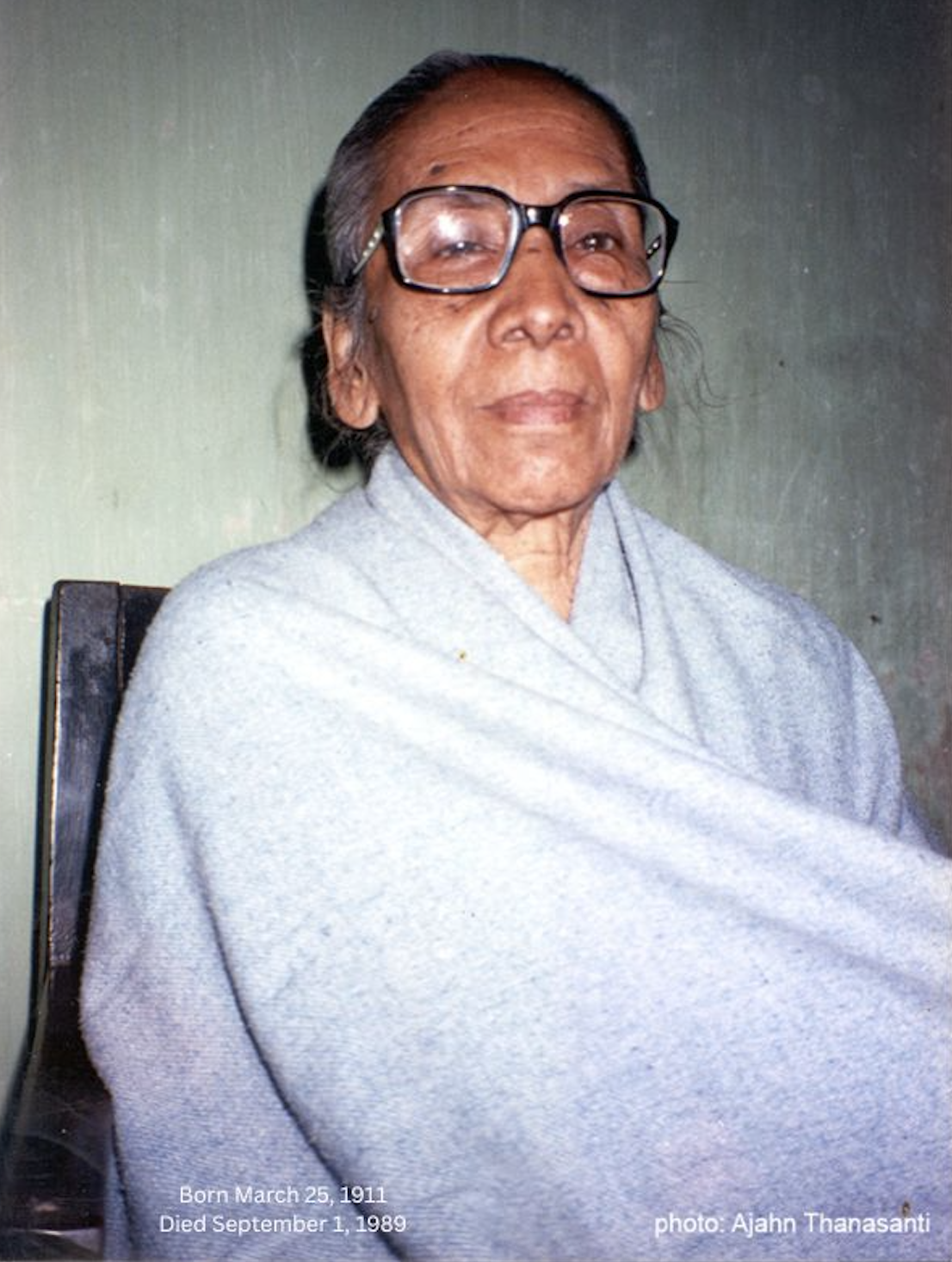
I first heard about Dipa Ma in 1979, sitting in Jack Engler’s class at UC Santa Cruz. I was seventeen, perched on the edge of my seat, falling forward into possibility. Jack had just returned from India, where he had spent time with Dipa Ma to understand what happens to the mind through meditation and awakening. His stories, some quiet and some astonishing, lit a live wire of determination in me: I wanted to give my life to the Dharma.
Years later, when I finally met her in Calcutta, I felt I had come home to what really matters.
In continuity with my recent blogs on spiritual abuse, patriarchy, and belonging, Dipa Ma’s life shows us how suffering can be transformed into seeds of awakening.
Her life, unvarnished and luminous
Born Nani Bala Barua in 1911 in Chittagong, she grew up with Buddhist roots and a deep sensibility for generosity. Life broke her open early: marriage at twelve, a move to Burma, long stretches of loneliness, illness, twenty years of infertility, betrayal, war, and then a brief, piercing brightness: a daughter, Dipa (“light”). More loss followed: another child died at birth, and soon after her husband died suddenly. Within a decade she had lost two children, both parents, her husband, her health, and her footing. A single mother in a foreign land, she was completely grief-stricken.
At the bottom of that well, she realized she had no interest in life as such. Only one thing seemed possible: meditation. She went all-in. What would bury most of us became fuel; what felt unendurable became the ground of practice. In time, her body steadied, her mind clarified, and her heart widened beyond measure.
Amy Schmidt’s books, Knee-Deep in Grace and Dipa Ma: The Life and Legacy of a Buddhist Master, gather many of these stories and show how her teaching spilled gently into kitchens, courtyards, and living rooms. By simply living, she showed awakening is not reserved for monasteries: it is possible in a crowded apartment, while cooking rice, holding a child, or answering the door.
“I can do anything that a man can do.”
One story that stayed with me came through Jack. Munindra-ji was teaching; the room was full of women and a few men. Someone asked about karma and the claim that only men can become Buddhas. Everyone thought Dipa Ma was asleep in the back. She sat up and said, clear and calm, “I can do anything that a man can do.” With these words she declared she had released the stranglehold of patriarchy; the laughter simply acknowledged her freedom.
Meeting her changed my life
Ten years after that class, I traveled to India and met her. The first time I sensed her, I wasn’t even facing her: a small figure wrapped in a white sari sat a few feet ahead on the floor of a meditation hall. Suddenly I felt a palpable field pressing against me, like a tide of presence coupled with kindness. I didn’t know who it was at first. Then I put it together: the impact was too immense. It had to be Dipa Ma.
Later, in her apartment, I received her blessing: tiny hands on my head, a soft chant. It felt like standing under a waterfall of love. Her presence was vast and oceanic; it rewired what I understood power to be. Not force. Not domination. A steadiness and capacity to be present, penetrating yet exquisitely tender.
I took a photo in her room that day. It is one of my treasures.
Root yourself in what matters most
Another memory: we were invited to celebrate a relative’s new apartment. It was a big moment. The apartment had a television, new kitchen equipment, and other features that signaled a level of affluence rare at that time. For the Barua clan, it was more than one family’s good fortune, it was a sign that reflected positively on everyone. The joy was collective, a huge celebration for the whole community.
I walked up the stairs with Dipa Ma, carrying her shoes. She stepped into the bustle with composure, no rush, no resistance, walked past the food drinks and chatter, and went straight to the Buddha. She bowed. That simple act still instructs me: root yourself in what matters most, then engage as you’re moved.
Planting a tree for her
After India I spent time in Thailand and later at Amaravati in England, where I became a nun. I planted a sapling in her memory in the Buddha Grove. For years it was unmarked. When I returned after being away for a few years, I went tree to tree, leaning my back against each trunk to recognize “hers.” Most felt solid, neutral. And then one felt like a waterfall of love. I knew I had found it. Later, Cathy Halter, who didn’t know its story, referred to it, unprompted, as “the mother tree.” Sometimes the Dharma does not need introductions; it announces itself.
The blessing that keeps giving
In a talk about her, I offered a simple practice learned by being with her: imagine Dipa Ma before you, tiny hands resting on your head, whispering a chant, blowing a blessing over your head. Feel love, steady, patient, immeasurable, filling shoulders, spine, belly, bones. Notice the softening. The space. The clarity that arrives without urgency. That love is not a memory; it is what presence feels like when the heart is unarmored. It is not just “hers.” It is the nature of awareness when nothing obscures its other faces: warmth and closeness.
Suffering is not an obstacle to awakening
Dipa Ma never glamorized pain. She did not bypass it either. She met it. She practiced in the middle of it. She let it teach her what is solid and what dissolves, what binds and what frees. Her life proclaims: suffering is not the gatekeeper we must defeat before we can awaken. Suffering can be the path itself, the very ground that grows patience, tenderness, insight, unshakable love, and a commitment to harmlessness.
Her example gave me permission to trust practice in the midst of shock, illness, and grief. When I finally met her, I remember thinking, “If my life ended now, it would be enough to have known this quality of love.” She gave me a living reference point, clarity and kindness braided together, that I could return to in the hardest seasons of my life.
Why she matters now
We are living through overlapping crises: old traumas resurfacing in new forms, deepening polarization, democratic destabilization, the grief of climate chaos, and the unthinkable reality of genocide. It is easy to feel daunted. Dipa Ma’s gift is the refusal to make an enemy of difficulty. She invites us to begin exactly where we are: to tie our shoes with awareness, to listen with our whole body, to let love be practical, stroking a child’s hair, washing a dish, answering a message with care.
She also showed me a form of power I trust: not “power over,” but power with. A power that co-regulates, dignifies, and steadies the nervous system by being profoundly present. This is the kind of power our world needs to heal what patriarchy, supremacy, and disconnection have broken. And it is the kind of power any of us can cultivate, one breath, one act rooted in what is important at a time.
Embodying What She Lived
- Prioritize. Orient to what you love before engaging the whirlwind.
-
Practice in the middle. Do not wait to feel better to begin. Begin now; the practice does its work.
-
Marry mindfulness with loving-kindness. Clear seeing that is also warm, interested, close.
-
Let blessing move through you. When you have been filled, share it back to teachers, friends, communities, and outward to all beings.
Today, I remember Dipa Ma: her strength, her gentleness, her fierce determination. She showed me that even in intense suffering, awakening is possible. May her life remind us that suffering itself can open the way to awakening and give us courage and love in these times.
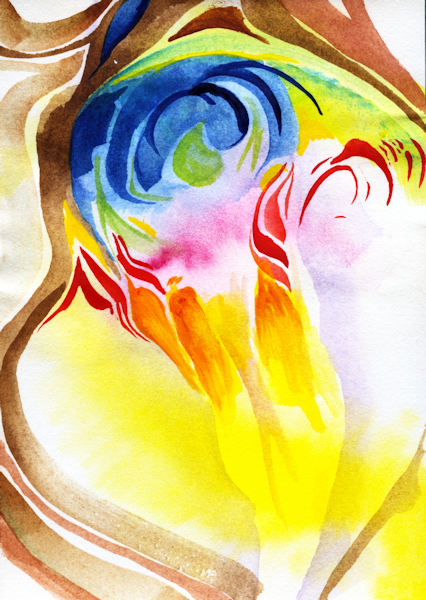
Painting by Mother Rosemary — a reminder that integrity and harmlessness can remain steady when everything else falls apart
By Amma Thanasanti
When the worst had unfolded in the monastery and I was searching for ground, I went to see Mother Rosemary—a dear friend who had lived as a professed Anglican nun for forty years. She knew our Buddhist community well and listened quietly as I shared my story. When I finished, she said only one thing:
“You have to follow your integrity.”
A few days later, she sent me a painting she’d made. To me, it carries the essence of her counsel: a vision of integrity shining through confusion and pain, of light breaking through the swirl of belonging and loss. It became an image I returned to again and again—a reminder that discernment and harmlessness can remain steady even when everything else falls apart.
When Belonging Overtakes Awakening
As nuns, we watched men arrive—sensitive, respectful, deeply committed to practice. They came with humility and reverence. But within three years, most had joined the pack. What began as genuine humility slowly hardened into subtle dismissal, entitlement, and superiority toward the nuns.
I came to see that something deeper had shifted. The longing to belong had quietly overtaken the aspiration to awaken.
This is not a flaw unique to monastics—it is a deeply human pattern. The pull of belonging runs through our nervous systems, our histories, our very sense of self. We fear exclusion more than we fear self-betrayal. And once a group’s consensus solidifies, it doesn’t just guide behavior—it becomes culture. A way of being. A lens through which everything is seen.
Culture forms not only through what is said, but through tone, body language, shared memory, silence, ritual, and unspoken expectations. It sets the boundaries of safety: who is trusted, who is centered, who is peripheral. Within such a container, conformity begins to feel like wisdom. And integrity—naming harm, breaking silence, choosing another way—begins to feel dangerous, because it risks exclusion, shaming, or exile.
And soon, preserving connection with the group feels more urgent than preserving connection with truth.
Echoes in the Wider World
The monastery was one expression of a pattern that plays out everywhere.
We see it when communities known for compassion begin echoing harsh or dogmatic views. Sometimes, this shift is born of prolonged suffering that narrows perception. Sometimes it stems from loyalty to a leader who insists this is the only way. And often, it happens inconspicuously—people conform simply because those around them do.
We see it when cruelty in leadership is tolerated—or even praised—because rejecting it would mean risking exile, disillusionment, or the loss of belonging.
Again and again, the same dynamic unfolds: the drive to belong eclipses discernment, dulls empathy, and clouds our ability to see the harm we are complicit in causing.
Ways of Noticing
Groupthink is slippery because it disguises itself as safety. Inside the group, it feels like belonging—a buffer against uncertainty, conflict, and loss. Aligning with the group soothes fear. Loyalty to a leader can feel like refuge. But when that belonging is bought at the cost of silencing others or ourselves, its foundation becomes brittle.
What feels like protection may, in fact, be complicity.
And harming others can feel protective in the moment. But it is not safe for the heart. Each small act of harm—justified or minimized—plants seeds of suffering within us. It dulls our clarity, erodes trust, and distances us from compassion. Outwardly, we may appear steady. Inwardly, we become brittle and divided—part of us straining to uphold our image, while another part quietly carries the truth of what we’ve done. This division weakens us from within, leaving us less whole, less free.
The belonging we gain through harming others is fragile, like ice too thin to stand on—it appears solid until it cracks beneath us. Fear may keep us there for a time, but the heart cannot rest on such ground. True belonging is like fertile earth beneath our feet—steady, nourishing, and alive.
When we participate in this dynamic, we are not merely protecting our place—we are reinforcing the very poisons the Buddha urged us to abandon. We deepen delusion. We harden aversion. We close the door to compassion. And we move further from freedom.
But there are signs, if we learn to listen:
- A knot inside. A tightening in the throat or stomach when something feels off.
- The hush of agreement. When honest exchange is replaced by silence or repetition.
- Recycled language. When slogans or borrowed phrases replace lived insight.
- The erosion of respect. When conviviality gives way to dismissal, superiority, or entitlement.
- A shift in values. When loyalty to a teacher outweighs commitment to ethical conduct.
- Protecting appearances. When preserving a tradition’s reputation matters more than upholding its core values.
- Avoiding accountability. When misconduct is minimized or ignored, and consequences disappear.
Noticing is the first act of freedom. It interrupts the spell. It brings what is hidden into the light.
Ways of Practicing
Once we notice, we begin to reclaim our power. Practice becomes medicine.
- Return to the body. Pause. Breathe. Feel your feet on the ground. This simple act disrupts the trance of conformity.
- Name what matters. Speak your values aloud. Write them down. Let them be your compass when the path is obscured.
- Reach for an ally. Even one person who sees clearly can offer steadiness when the group feels overwhelming.
- Create space for clarity. Time in nature or silence reconnects you to your own knowing.
- Deepen your commitment to harmlessness. If you’ve taken precepts, return to them often. Reflect on how it feels to be in the presence of someone who will not harm you—and ask: is this the gift I want to offer others?
Remember the wise guardians of the heart:
- The inner voice that recoils from causing harm.
- The sober awareness that actions carry consequences—for ourselves and for others.
These are not lofty ideals; they are quiet, steady truths. They re-anchor us in what is real.
Is Harm Ever Necessary?
In a polarized world, we are often told that harm is necessary—that cruelty is justified for the sake of safety or justice. History holds painful examples: force used to restrain violence, protect the vulnerable, or respond to grave injustice.
But the deeper question is not just what action is taken, but from what inner ground it arises.
If harm is driven by fear, rage, or retribution, it feeds the very poisons the path is meant to uproot. Even necessary restraint, if grounded in compassion—for both the vulnerable and those who cause harm—carries a different energy. It is fierce, but not cruel. Protective, but not punishing.
Harmlessness is not passivity. It can be sharp, clear, and strong. But its aim is always to minimize harm, to resist dehumanization, and to hold the sacred weight of our actions. Belonging built through cruelty is an illusion. Real refuge is rooted in integrity.
Coming Back to Discernment
In 2008, during the Pavāraṇā ceremony—a Buddhist ritual where monastics traditionally invite feedback from one another—the monks had altered the tradition in ways that redefined it as a tool of subjugation toward the nuns.
When the moment came, I couldn’t stay silent. I spoke respectfully but clearly: I could not find a place of integrity from which to participate.
Outwardly, I lost nearly everything. I became a target. I was coerced, isolated, and eventually left the community I had devoted my life to. But inwardly, something essential remained intact. I had not betrayed what mattered most.
It has taken years to recover from the trauma and exile that followed. But unlike many who endure spiritual abuse, my healing did not involve relearning how to trust myself. That trust was never broken. I had acted from a place of deep alignment. My commitment to harmlessness had held—and it continues to guide me still.
Discernment may cost us belonging in the short term. But it preserves something deeper: the belonging to ourselves, to truth, to love. A belonging no institution or authority can grant—or take away.
We may lose our way for a time, swept into silence or collusion. But we can return. And each return strengthens the ground beneath us. Eventually, discernment is no longer just a private act—it becomes a shared refuge we build together.
As the commitment to harmlessness grows, it becomes like granite. The tides of fear, longing, and loss may wash over it, but they do not move it. Even when the heart quakes, integrity remains still and steady.
A Compass in the Storm
In my own journey, Mother Rosemary’s words—“You have to follow your integrity”—and the image she painted became a compass. A reminder that integrity and harmlessness are not abstract ideals, but living forces. They can guide us when everything else collapses.
So I invite you to pause and ask:
Where in your life do you feel the pull of belonging pressing against your values? And what would it mean to let integrity—and a commitment to harmlessness—lead the way?
Reflection for Daily Life: Belonging, Integrity, and Harmlessness
Take a few quiet minutes to reflect on these questions:
- Notice the pull of belonging. Where in your life do you feel pressure to conform, even when it conflicts with your deeper values?
- Strengthen harmlessness. Recall what it feels like to be with someone you know will not harm you — the ease, trust, and safety of their presence. Do you wish to be that presence for others?
- Affirm your commitment. If you have precepts or guiding values, speak them aloud or write them down. Let them be a compass when you feel lost.
- Call on the guardians of the heart. Feel the inner sense of conscience that recoils from causing harm. Remember the wise awareness of consequences, knowing that unwholesome actions bring suffering to yourself and others.
- Return to the body. Pause, breathe, and let your feet touch the ground. Rest in the clarity that arises when you step back from the tide of conformity.

From Patriarchy to Respect: Healing the Deep Divide
By Amma Thanasanti
Patriarchy is not only a system of the past; it is alive and pressing upon us now. Intertwined with racism, colonialism, and capitalism, it shows up in the rise of authoritarian leaders, assaults on women’s rights, racial and economic hierarchies, and the exploitation that drives climate collapse. These forces of dominance and control are reasserting themselves aggressively, even as their old institutions falter. The patterns are familiar: greed and disregard for life overriding care; power maintained through intimidation and exile.
What I lived through in the monastery was a microcosm of this larger pattern. Patriarchy there was not abstract but intimate. Male authority enforced subordination. Ceremonies intended by the Buddha for uplift and reflection were reshaped to reinforce male dominance. Nuns were compelled to participate in rituals and submit to rules that stripped away not only their dignity but their role as co-leaders — diminishing whose voices counted in shaping community life. Where leadership and decisions were concerned, structures were reshaped to reinforce male authority. Subordination was no longer limited to ritual; it became the very structure of belonging, imposed as a way of life. And those rules continue today.
This reveals patriarchy’s conundrum: it demands respect while destroying the very conditions in which mutual respect can grow. Its impact on community trust was profound. Patriarchal pressure seeped into our relationships in two ways. First, it eroded the bonds we had with one another, corroding trust and connection. Second, it shaped our attitudes: success became defined by the ability to dominate, so we found ourselves competing with or demeaning our sisters instead of supporting them.
The harm was both structural and personal. Constant scrutiny, exclusion, and coercion eroded any sense of safety. Silence was demanded. Conformity enforced. Dissent punished. At its root, patriarchy fosters a wound of insufficiency: you don’t matter unless you dominate; you can’t belong unless you submit.
This mirrors what psychology calls the narcissistic wound — the voice inside that insists, “This is about me, what I need, what I was denied.” In the monastery, it spoke through other voices: “Protect the tradition. Protect the lineage. Maintain loyalty to the teacher.” Both the personal wound and the patriarchal system operate through the same double-bind. Either dominate or disappear. Either submit or be cast out. Both arise from the fear of being unseen, unloved, and unworthy.
When met with awareness, this cycle begins to loosen. We no longer need to dominate or submit, because awareness itself brings a deeper belonging — resilient, steady, already whole.
And yet, even in such conditions, seeds of resilience emerged. Refusing to comply with unjust structures became a way of honoring truth. Choosing dignity over submission, even at great cost, became a practice of integrity. These acts of resistance were not about tearing down community but about remembering what is truly important.
This same choice faces us now. Around the world, people are standing up to abusive systems whether defending the climate, racial justice, democratic freedoms, or speaking out against war and exploitation, people everywhere are protecting what is sacred and life-giving.
What is needed now is not only dismantling structures of control but cultivating ways of relating rooted in respect and responsibility. A third way is possible: neither submitting to the authoritarian hierarchies and patriarchal legacies reasserting themselves across the world, nor collapsing into fragmentation, but listening and caring at the deepest levels.
This requires clarity — both outwardly and inwardly. Outwardly, we must build systems of accountability, transparency, and shared power. Inwardly, the question becomes: Where do we place attention? How do we befriend fear so courage can grow?
Practice begins in how we meet fear. Meeting it with breath and awareness steadies the body and softens the grip. Then we turn toward the narcissistic wound itself, pouring presence into its emptiness like drops into the Mariana Trench — dark, vast, and seemingly bottomless. Slowly it fills, bit by bit. Not with grasping, but with awareness. With presence, the wound that once demanded domination or submission is held in a wider field until what felt like a vast crevasse — an emptiness devoid of warmth — reveals itself as spaciousness.
As awareness deepens, the field shifts. Instead of being consumed, we can see. Instead of being trapped in “me,” we find awareness already here — resilient and steady. From this ground, we discover wholeness. Love emerges, not as sentiment but as essence.
This is how we mend what patriarchy has broken:
Meeting fear with presence.
Tending emptiness with awareness.
Letting love rise from the depths.
In this way, healing continues — and what matters most becomes the ground beneath us.
Awakening Truth Newsletter!